Yetta Russell’s life has never followed a straight line.
She finished college on her own timeline, skipped the traditional nine-to-five world and moved between fashion merchandising and service-industry jobs. But one thread has always held: clothes.
Two years ago in Lafayette, Russell started her own clothing line — Tenant. It’s about thoughtfully produced and curated clothing that focuses on sustainability. Her aim is simple — make people feel confident in what they wear and offer distinctive pieces that last.
“The idea of Tenant is that you live in your clothes,” Russell said. “You’re an occupant of these, and this is your house. You want to feel good in your house.”

Two years ago in Lafayette, Yetta Russell started Tenant, a thoughtfully produced and curated clothing line that focuses on sustainability. With a brick-and-mortar shop in Baton Rouge, she’s still attending pop-ups and markets on the weekends.
After ricocheting between cities and hosting pop-ups around Louisiana, Russell has settled into Baton Rouge, where she’s set to open Tenant as a brick-and-mortar store in Mid City.
“This is the first time I have something that’s mine,” she said. “The idea, it’s all falling into place.”
Her soft opening is set for Dec. 10 at 2558 Government St., with a grand opening on Dec. 12. The store will be open 11 a.m. to 5 p.m. Wednesday through Friday, with additional private-appointment hours.
Steeped in style
Fashion has long been part of Russell’s world. Her paternal grandmother owned a women’s and children’s store in London. Her maternal grandmother worked in makeup. Her British father worked in high-end shops and likes to be “put together.” Her mother — an artist who lived in Mexico — never dressed like “your typical J. Crew mom.”
Tenant began as a side project while Russell managed Wild Child, a wine shop in Lafayette. Before that, she spent four years as a buyer for Genterie Supply Co., curating women’s collections. She tried New York, working in wholesale fashion, then came back to south Louisiana and worked in the service industry.
After a few years, Russell returned to Tenant and started hosting pop-ups and placing merchandise in stores around Lafayette and New Orleans.

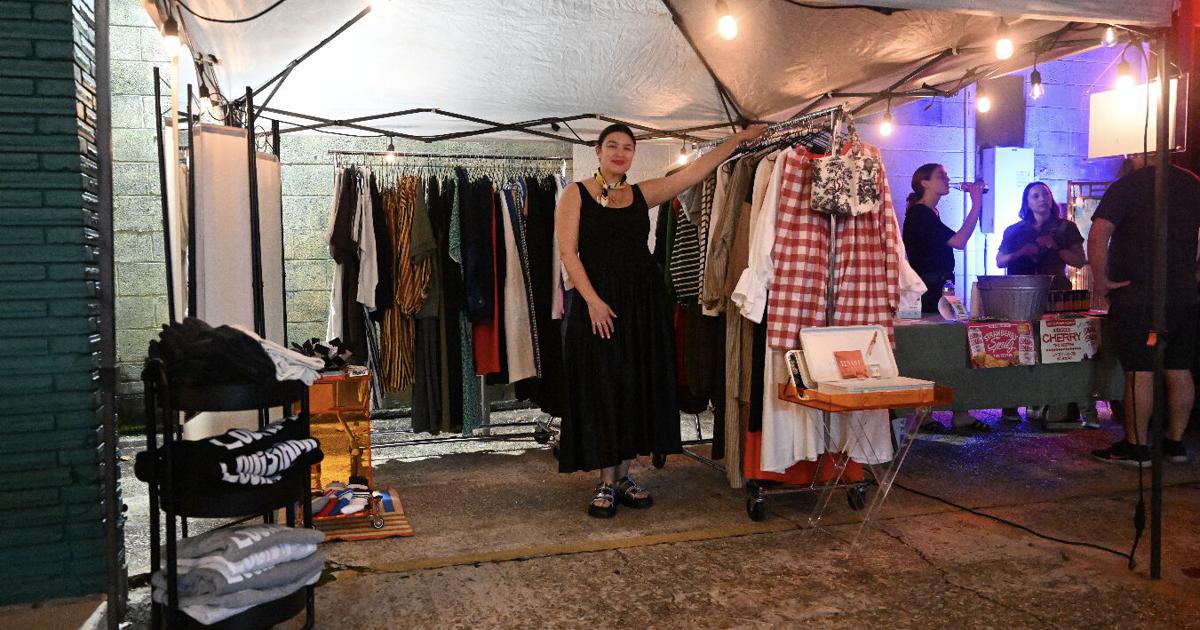
Yetta Russell stands in her booth, Tenant Store, Friday, November 21, 2025, during White Light Night in Baton Rouge, La.
As the business grew — and began taking over her floor space — Russell stepped away from her job to focus entirely on fashion. This year, she and her family moved to Baton Rouge. In November, she set up a booth at her first White Light Night, just outside what is now her permanent, 150-square-foot shop next to Rad Dad.
Sustainability at the core
Russell’s goal with Tenant is longevity — pieces people can wear for years.
“What I’m carrying is consciously produced, independent brands. The idea is, maybe you’re investing a little bit more in your wardrobe, but it’s going to be more of a long-time investment,” she said. “I try to carry things that are season-less and timeless.”

Danielle Honeycutt, an instructor and fashion anthropologist with LSU’s Department of Textiles, Apparel Design and Merchandising.
Her focus on sustainability means paying attention to how and where clothing is made and pushing against the churn of fast fashion — the high-speed production of inexpensive, trendy clothing that creates immense waste.
LSU instructor and fashion anthropologist Danielle Honeycutt studies how people interact with clothing socially and psychologically. Fast fashion, she said, has grown rapidly, with massive environmental consequences — something she and colleagues are working to “lighten.”
Elsevier, a scientific publishing company, reports that fast fashion has dramatically expanded clothing production and consumption, generating waste at every stage of manufacturing. According to Khairul Akter et al. (2022), about 53 million tons of textile fibers are consumed each year, resulting in more than 92 million tons of global textile waste — 73% of which is incinerated or discarded, representing over $100 billion in wasted raw materials annually.
“According to Khairul Akter et al. (2022), roughly 53 million tons of textile fibers are consumed each year, which leads to over 92 million tons of textile waste being produced each year worldwide, 73% of which is incinerated and/or discarded, which represents a waste of over USD100 billions worth of raw materials annually,” the journal article stated.

Yetta Russell’s curated clothing line, Tenant, focuses on consciously produced, independent designers.
Honeycutt notes that small changes in consumer habits can help, especially efforts tied to the circular economy.
“If we can keep things in the fashion cycle for a longer amount of time, that has been proven as an effective way, overall, to combat some of this textile waste and textile pollution,” she said.
Rental fashion, vintage shopping and clothing swaps can all play a role. But she also stresses that sustainable options must be more widely accessible.
“Sustainable can’t just mean expensive,” she said. “It has to be accessible for everyone.”
Among the eco-friendly brands Russell carries are Toit Volant, kowtow and Le Bon Shoppe.
Building a capsule wardrobe

Yetta Russell’s clothing line, Tenant, carries independent designers like Best Regards, based in California.
Russell’s own style has evolved since becoming a mother. She’s now focused on a capsule wardrobe — a small collection of versatile pieces she can wear repeatedly.
Honeycutt notes this approach is common in France, where women learn it from a young age.
Russell now puts more thought into her clothes so that she feels “put together for the day.” She said it’s easy for people to get lost in the role of parenting, but she feels more human when she gets dressed with intention.
“I love that fashion can help you express your individuality and feel comfortable being you, because that’s what clothes are about,” Russell said. “Someone telling you, ‘I love what you’re wearing today’ is the best feeling, personally, that I could get.”
link