Sustainable Fashion Market
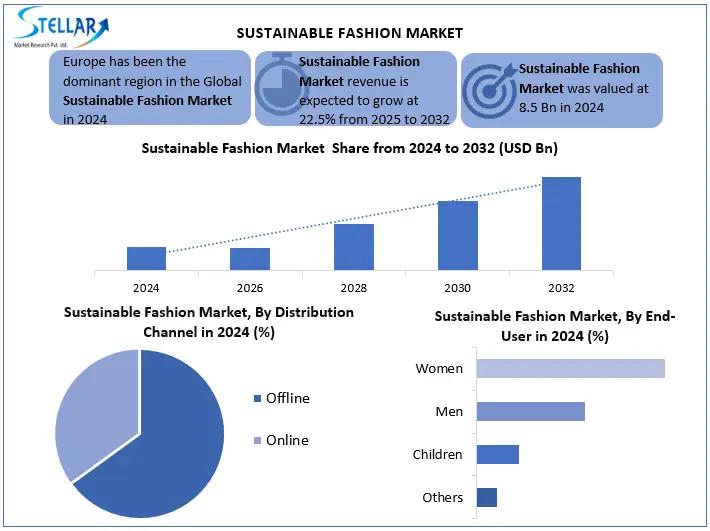
The Sustainable Fashion Market was valued at USD 8.5 Bn in 2024 and is expected to reach USD 43.1 Bn by 2032, at a CAGR of 22.5% during the forecast period.
The sustainable fashion market is transforming the apparel and textile industry by aligning style with environmental responsibility and social ethics. As climate change, resource scarcity, and social accountability become central concerns, fashion brands and consumers alike are shifting toward sustainable alternatives. Sustainable fashion emphasizes eco-friendly materials, ethical labor practices, circular production models, and reduced environmental impact-making it one of the most influential movements reshaping the future of the fashion industry.
Get Full PDF Sample Copy of Report: (Including Full TOC, List of Tables & Figures, Chart) @
Market Dynamics
The sustainable fashion market operates within a complex ecosystem influenced by environmental awareness, regulatory pressure, evolving consumer behavior, and technological innovation. Traditional fast fashion models-characterized by high volumes and short product life cycles-are increasingly scrutinized for their environmental footprint and labor practices.
In response, brands are adopting sustainable materials such as organic cotton, recycled polyester, bamboo, hemp, and innovative fabrics derived from agricultural waste. Digital tools including AI-driven design, blockchain-based supply chain transparency, and on-demand manufacturing are supporting sustainable transformation. However, challenges related to cost, scalability, and consumer education continue to shape market dynamics.
Key Market Drivers
Rising Environmental & Climate Awareness
Consumers are becoming more conscious of fashion’s contribution to carbon emissions, water consumption, and waste, driving demand for sustainable alternatives.
Ethical Consumerism & Social Responsibility
Growing concern over labor rights, fair wages, and safe working conditions is pushing brands toward ethical sourcing and transparent supply chains.
Regulatory Pressure & Sustainability Mandates
Governments and global organizations are introducing stricter regulations on textile waste, emissions, and chemical usage.
Growth of Circular Fashion Models
Resale, rental, repair, and recycling models are extending product lifecycles and reducing waste.
Innovation in Sustainable Materials & Manufacturing
Advances in biodegradable fabrics, low-impact dyes, and water-efficient production are accelerating market adoption.
Get access to the full description of the report @
Market Opportunities
• Expanding demand for circular and regenerative fashion models
• Growth in eco-friendly athleisure and casual wear
• Rising adoption of rental, resale, and second-hand platforms
• Increasing use of AI and digital design to reduce waste
• Opportunities in emerging markets with eco-conscious youth populations
• Collaborations with sustainable material innovators
• Expansion of certification-based and transparent fashion brands
Brands that combine sustainability with affordability, design appeal, and transparency are well positioned to capture long-term growth.
Industry Pain Points
Despite growing interest, the sustainable fashion market faces key challenges:
• Higher production and material costs
• Limited scalability of sustainable raw materials
• Consumer confusion due to greenwashing
• Complex and fragmented supply chains
• Price sensitivity in mass-market segments
• Lack of standardized sustainability metrics
Addressing these pain points is critical for mainstream adoption and industry credibility.
Market Segmentation
By Product Type
Apparel
Footwear
Accessories
Jewellery
Bags
Others
By Fabric Type
Recycled Fabrics
Organic Fabrics
Regenerated Fabrics
Natural Fibers
Alternate fibers
Others
By End-User
Men
Women
Children
Others
By Distribution Channel
Online
Offline
Get Full PDF Sample Copy of Report: (Including Full TOC, List of Tables & Figures, Chart) @
Regional Insights
Europe – Sustainability Pioneer
Europe leads the market with strong regulatory frameworks, eco-conscious consumers, and widespread adoption of circular fashion practices.
North America – Ethical & Premium Growth Market
The US and Canada show rising demand for ethically produced and premium sustainable fashion, supported by strong e-commerce penetration.
Asia-Pacific – Fastest Growing Region
China, India, Japan, and Southeast Asia are witnessing rapid growth driven by urbanization, rising disposable income, and increased sustainability awareness.
Latin America – Emerging Ethical Fashion Hub
Local craftsmanship, sustainable fibers, and community-driven fashion models support regional growth.
Middle East & Africa – Niche but Expanding Market
Luxury sustainable fashion and ethical sourcing initiatives are gradually increasing adoption.
Key Players in the Sustainable Fashion Market
North America
Patagonia (USA)
Everlane (USA)
EILEEN FISHER (USA)
Pact (USA)
ABLE (USA)
Tentree (Canada)
Rothy’s (USA)
Nike (USA)
Europe
Stella McCartney (United Kingdom)
Armedangels (Germany)
Veja (France)
PANGAIA (United Kingdom)
We aRe SpinDye (Sweden)
H&M Group (Sweden)
Recover Textile Systems (Spain)
Boden (United Kingdom)
Finisterre (United Kingdom)
Inditex / Zara (Spain)
Adidas (Germany)
Puma (Germany)
Asia Pacific
KPR Mill Limited (India)
Fast Retailing / Uniqlo (Japan)
Adidas (Germany)
Nike (USA)
Under Armour (USA)
Middle East & Africa
Shein (Singapore)
South America
Natura &Co (Brazil)
Veja (Brazil)
Frequently Asked Questions
1. Which region has the largest share of the global sustainable fashion market?
Europe holds the highest Sustainable Fashion market share in 2024.
2. What is the projected sustainable fashion market?
According to the sustainable fashion market revenue forecast market is expected to grow at a compounded annual growth rate (CAGR) of over 22.5% during the forecast till 2032.
3. What is the significant sustainable fashion market segment by product type?
The apparel had the largest share in the global sustainable fashion market by product type.
4. What are the major drivers for the global sustainable fashion market?
Consumer demand for ethical and eco-friendly products, coupled with increasing awareness about environmental impact, serves as the primary driver propelling the growth of the global sustainable fashion market.
5. Who are the major Sustainable Fashion market players?
The top players in the market are Patagonia, Stella McCartney, H&M Group, Adidas, Veja, PANGAIA, and Everlane.
Explore More Reports:
Hand sanitizer Market:
Handbag Market:
Europe Handbag Market:
North America Handbag Market:
Shaving Lubricants Market:
Asia Pacific Handbag Market:
Toys Market:
Kenya Fish Finder Market:
Linkedin Blogs:
https://www.linkedin.com/posts/akash-pingale-0a20a530b_paperandpulp-packagingindustry-sustainablematerials-activity-7417184026416947202-CcTX?utm_source=share&utm_medium=member_desktop&rcm=ACoAAE7bfDoBUwiCU51F5FycQYAJ8XFM9ob3DxU
S.no.8, h.no. 4-8 Pl.7/4 Kothrud
Pinnac Memories Fl. No. 3
Kothrud, Pune, Maharashtra, 411029
[email protected]
+91 9607365656
Stellar Market Research is a multifaceted market research and consulting company with professionals from several industries. Some of the industries we cover include medical devices, pharmaceutical manufacturers, science and engineering, electronic components, industrial equipment, technology and communication, cars and automobiles, chemical products and substances, general merchandise, beverages, personal care, and automated systems. To mention a few, we provide market-verified industry estimations, technical trend analysis, crucial market research, strategic advice, competition analysis, production and demand analysis, and client impact studies.
This release was published on openPR.
link